


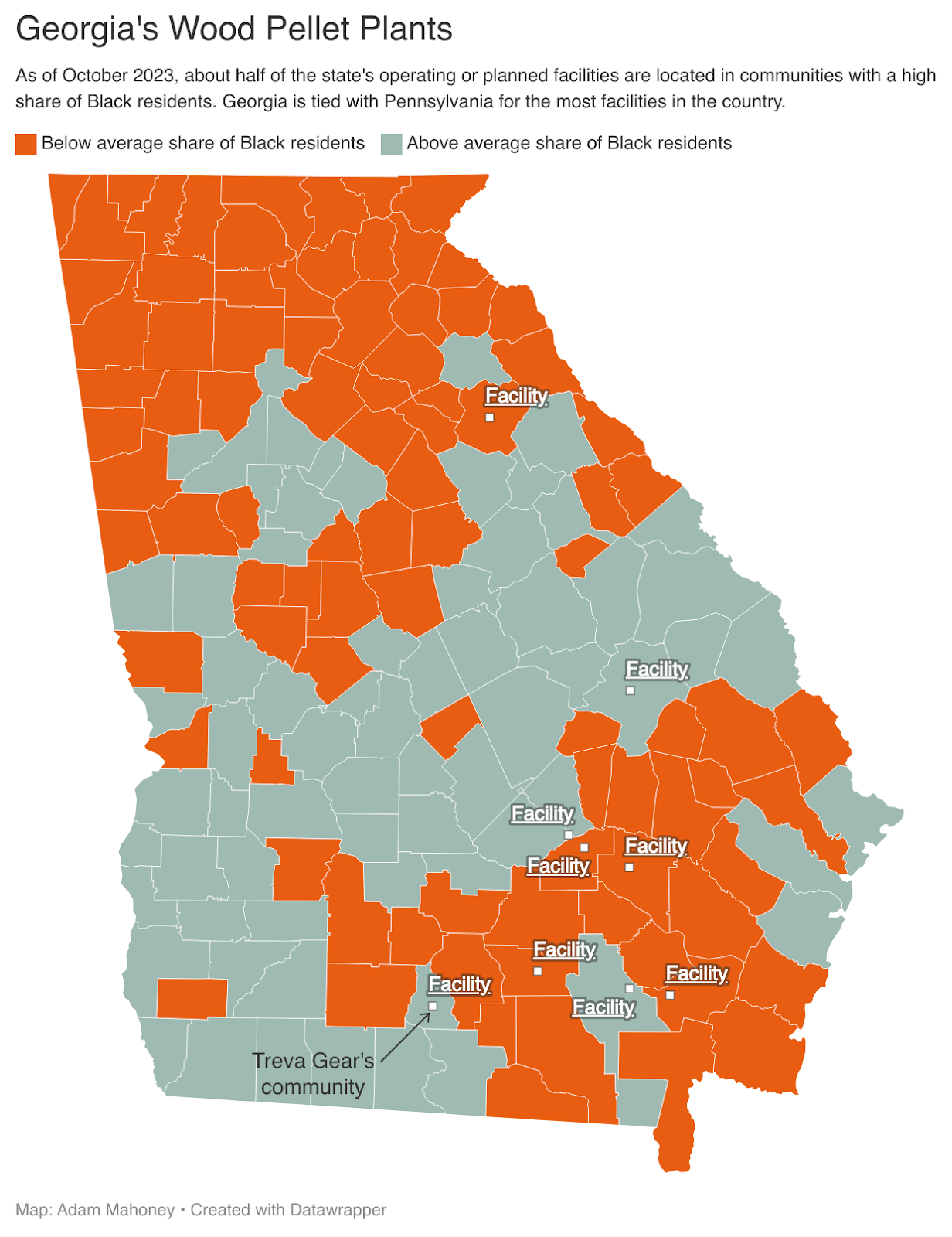
Treva Gear doesn’t want the forest in her town of Adel, Georgia, to be the next place “sacrificed” for someone else’s energy needs. However, a new tax credit proposed in the nation’s largest climate spending bill may make it more likely for her community and dozens of others.
The credit could accelerate the construction of plants that convert large swaths of American forest into an energy source called biomass that scientists say is dirtier than coal.
A private company is on the verge of building one of the plants in Adel. It would be the largest in the world and emit carcinogenic air pollution.
“Ultimately, we’re killing the Earth and each other,” said Gear, who began rallying her neighbors after the plant was proposed in 2020 and has a complaint with a Georgia environmental agency. “It’s supposed to be a solution — that’s a lie. It’s a false climate solution that leaves Black and brown communities still bearing the brunt of the damage.”
For years across the rural South, the forests that Black communities have called home for hundreds of years have been significantly depleted. In the name of “clean energy,” more than a million acres of the nation’s forests, primarily in the South and Northeast, have been cleared by private energy companies, stripped down, and reduced to wood chips. At plants in the community, the pellets are smoothed into uniform wood pellets and sold to power plants primarily in Europe. The pellets are then burned at power plants for electricity, creating what is known as biomass energy. The industry says it is cleaner than burning coal, but according to a coalition of nearly 1,000 scientists, it actually releases far more carbon into the atmosphere than coal. It also cuts down trees, an important tool for fighting climate change.

For generations, the South’s forests have kept communities afloat, protecting them from floods while also sucking up air pollution, but the wood pellet boom has disrupted that and contributed to diminishing ecosystems and increased flood threats. It comes with little financial or health benefits for the Black communities that depend on the environment and is akin to living next to a perpetual campfire. Stinging eyes and closed throats resulting from the ash and dust caked into everything.
These plants emit more than 55 air pollutants known to contribute to respiratory illnesses and cancer. With 45% of the nation’s operating or proposed plants located in the South, they’re more than twice as likely to be located in predominantly Black and poor communities than white and wealthy ones.
Georgia and Pennsylvania, which each have nine plants, have more than any other state. Currently, the world’s largest plant is located in Lucedale, Mississippi, which the White House deems disadvantaged because of its high wildfire and flood risks. In another Mississippi town, Gloster, a mill operates just 500 yards away from homes.
All the while, about 80% of the 9 million tons of pellets produced in America every year are shipped across the Atlantic and burned by utility plants in Europe, meaning the extraction doesn’t help alleviate any of the energy burdens of these rural communities. The South uses the least energy nationwide but has the highest energy bills and the dirtiest energy sources.
Biomass supporters say the industry’s growth is just the product of the world’s increasing energy demand and the need to keep the lights on as the use of fossil fuels declines. The argument relies on the belief that a large-scale transition to solar and wind power is not feasible.
But researchers and advocates say the growth of wood pellet plants and exports is another last-ditch effort by American and European energy companies to make immense profits from a cheap, pollution-intensive energy source before the mass transition to solar and wind power. (Biomass is cheaper to produce than coal and gas, but actually more expensive than solar and wind.)
Even with stricter pollution regulations in the United Kingdom, European Union, and United States, many companies have evaded scrutiny by underreporting emissions or by just paying the multimillion-dollar fines levied on them for surpassing limits.
Understanding the “predatory nature of this clean energy source”
Gear and others say it is another example of America’s Black communities being exploited by global trade.
“They’ve created sacrifice zones for profit, for ‘economic progress,’” said Gear.
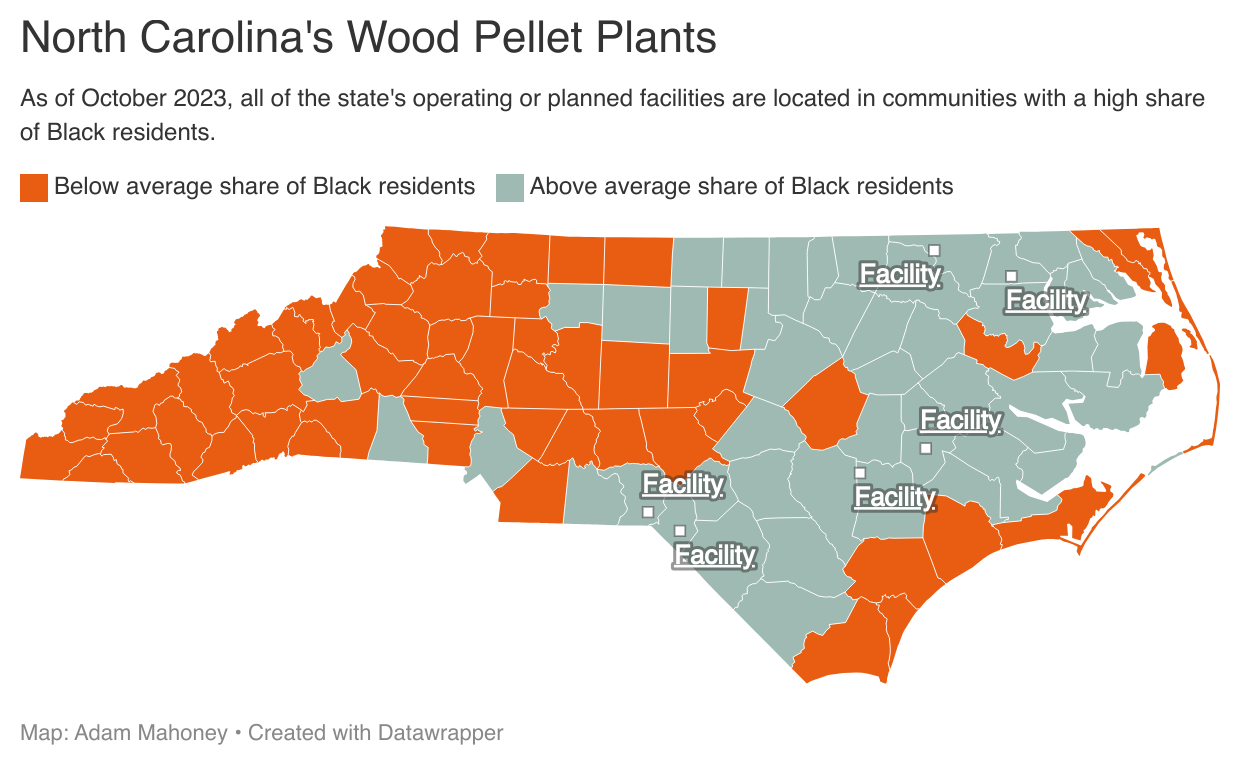
Belinda Joyner, an environmental activist in North Carolina, says the increase in the biomass industry should be treated like a mental health crisis in addition to an environmental one. In her state, there are six wood pellet plants.
“We have log trucks bumbling down our streets constantly making noise 24/7,” she said. “We’re not getting proper rest, which can affect you in a lot of ways, especially when we get up and work so hard every day to pay for our homes. It’s disrespectful because these people know they wouldn’t put these facilities in their community.”
Adel, Georgia, is a small, rural town of 5,000 people marked by its deep agricultural and forestry roots and a close-knit community. Surrounded by farmlands that were once the economic engine for the region, it’s a place where tradition holds strong.
Growing up, Gear, who is in her 40s, remembers playing stickball in the streets of Adel with her brother and friends after school and riding her bike across town to the library to spend hours reading.
“It was the kind of place you want to raise your kids in,” she said, but that all changed after Georgia granted Spectrum Energy Georgia permits to construct and operate a wood pellet plant in the community. Spectrum Energy did not respond to Capital B’s request for comment.
The White House already considers the small town “disadvantaged” because of its poor health outcomes. Yet, the tax credit proposed by the Biden administration through the Inflation Reduction Act, the largest climate spending bill ever, may help intensify the community’s health problem. The credits would help subsidize the construction of these kinds of plants or new facilities that would help offset the environmental impact of the plants by sucking carbon emissions out of the air.
Read More: The Country’s Largest Climate Bill Threatens to Leave Black Communities Behind
The Biden administration, mainly the U.S. Treasury Department, is now sifting through competing claims about the environmental risks and benefits of burning wood. America’s forests are actually one of the country’s most important climate tools. Domestic forests absorb around 11% of our greenhouse gas emissions each year.
Later this year, the Treasury is expected to decide if it will allow biomass companies to reap tax breaks worth hundreds of millions of dollars over the next decade. Former President Donald Trump’s administration first declared the forest biomass industry as renewable, the same as solar or wind power, opening the floodgates for the industry to utilize federal clean energy tax credits.
While the Biden administration isn’t to blame for the initial framing of the practice as “renewable,” Gear questions how, despite the administration’s big investment in making sure communities of color don’t remain disproportionately harmed by pollution and climate change, “industry is still allowed to walk through the back door into our communities.”
Last year, Gear brought a Title VI civil rights complaint against the Environmental Protection Division of the Georgia Department of Natural Resources. The complaint alleges that the state’s air quality program does not do enough to identify and protect the most vulnerable Georgians. As Capital B has reported, the environmental civil rights complaint process is under attack by Republican attorneys general, so it is unclear what success she might find.
“The attorneys generals that we pay with our tax dollars attempting to roll back our civil rights to clean air and water is unconscionable,” she said.
Read More: The Court Ruling That Guarantees a Future of Environmental Racism
Earlier this year, a coalition of U.S. representatives sent a letter to Energy Secretary Jennifer Granholm and IRS Commissioner Daniel Werfel in opposition to the tax credit. And in April, U.S. Sen. Cory Booker of New Jersey introduced a bill requiring the Environmental Protection Agency to be more stringent in tracking pollution from these types of facilities.
A recent study from the University of North Carolina at Chapel Hill and the National Wildlife Federation found that wood pellet manufacturing plants tend to underreport emissions, and facilities generating electricity from biomass can emit more pollutants than fossil fuels or even coal. The industry’s green claims largely rely on wood pellet companies replacing the razed forest growth with new trees, but young trees aren’t as good as sponges as the old ones they’ve replaced.
Additionally, many wood pellets are “co-fired” alongside coal in traditional power plants, allowing companies to get green energy credits while still burning coal.
Adam Colette, program director with the Dogwood Alliance, a North Carolina-based environmental nonprofit, has said the Biden administration’s climate bills are actually “one of the biggest emerging threats to southern forests.” For each pound of wood pellets produced, 12 acres of forest are destroyed. Forty pounds of pellets are needed to heat an average-sized European house during the winter.
Since the advent of U.S. colonization, the country has destroyed 95% of its old-growth forests. With fewer trees, that means more greenhouse gasses in the atmosphere. As the “wood basket of the world,” the South’s forests are already being razed for other industries, providing as much as 20% of the world’s paper and other wood products.

In Gloster, Mississippi, an 80% Black community where homes border a pellet plant, the average resident earns $15,000 annually. The community has no local schools and a single small health clinic with no full-time physicians. About a third of the town’s residents report having poor health, according to the Centers for Disease Control and Prevention.
“This is real. Visit our communities and see the conditions of life for folks. Come see the sawdust raining on people, and talk to them and hear their stories about their medical issues, breathing issues, and dependence on oxygen tanks,” said Gear. “Then you’ll understand the true predatory nature of this ‘clean energy’ source.”
You can leave a public comment for the IRS here regarding their proposal to extend the biomass tax credit.